Structure
Red blood cells are discoid-shaped cells, roughly 8 μm in diameter
The plasma membrane of a mature red cell is made up of many transmembrane proteins that regulate the unique properties of deformability, tensile strength, and cell shape.
An RBC must repeatedly deform through 2-to 3-μm capillaries during its 120-day lifespan and it must withstand the shear stresses of the circulation.
The flattened shape of the erythrocyte maximizes surface area, allowing for faster diffusion and absorption of O2 and CO2.
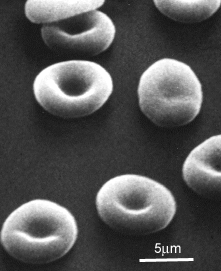
This scanning electron micrograph (courtesy of Dr. Marion J. Barnhart) shows the characteristic biconcave shape of red blood cells.
This is partly due to the arrangement of the actin cytoskeleton that lies just underneath the plasma membrane, and partly because the nucleus is absent.
This means that the cells can deform easily, and have a high surface area/volume ratio - good for exchange.
Mature erythrocytes are anucleate and contain few organelles.
Immature erythrocytes, called reticulocytes, normally account for 1-2 percent of red cells in the blood.
